Blog
The Meeting You Should Have Cancelled
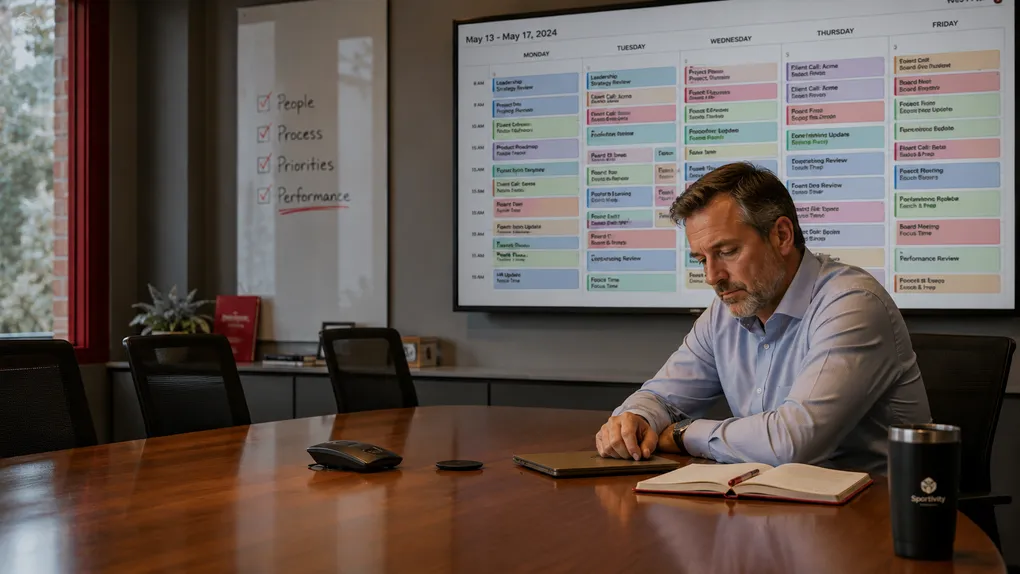
A director I was working with last month pulled up his calendar to show me the week ahead. It was a solid block of colour. Back to back, nine in the morning until half five, every day. No white space anywhere. He said it like a badge, “This is what running a business looks like.”
I asked him to pick one meeting on that screen, any one, and tell me what decision it was going to make. He looked for a while. Then he said, “I’m not sure that one actually decides anything. We just always have it.”
There it was. The meeting he should have cancelled, sat there in the diary, every week, quietly eating a chunk of his best thinking time.
The number nobody wants to say out loud
Fresh research this year put the average executive at nearly 23 hours a week in meetings. That has more than doubled since the 1960s. The average professional is now up around 21 and a half hours, which works out at ten full working weeks a year sat in rooms and on calls.
Here is the part that stings. When Harvard Business Review asked 182 senior managers, 71 per cent said their meetings were unproductive. Most people in the room already know the meeting is a waste. They just keep turning up.
We have somehow decided that a full calendar means a serious business. It doesn’t. It usually means nobody has stopped to ask what the meetings are for.
Meetings are not the work
This is the bit I want SME owners to really sit with. A meeting is not the work. It is a tool for doing one of three things, and only three.
Making a decision. Solving a problem that genuinely needs more than one brain. Or building a relationship that matters.
That’s the list. If a meeting isn’t doing one of those three, it is an update. And an update does not need a room, a diary slot, and eight people’s attention. It needs a message everyone can read in their own time.
Over half of remote workers already say most of their meetings could have been an email. They are right. The problem is that cancelling a meeting feels rude, and sending a written update feels like you are dodging. So the meeting survives, year after year, long after anyone remembers why it started.
The one question
Here is the test I gave that director, and it is the whole point of this piece. Before any meeting stays in your week, ask one thing.
What decision does this meeting make, and who makes it?
If you can answer that cleanly, keep the meeting and invite only the people who touch that decision. If you can’t answer it, you don’t have a meeting. You have a habit.
Run that question across your recurring meetings this week. Not the one-offs, the repeats. The standing Monday catch-up. The weekly review that has drifted into a chat. The team call that exists because it has always existed. Most owners I do this with find two or three that fail the test on the spot.
Kill one of them. Just one, to start. Replace it with a short written update if people still need the information. Then watch what happens to the hour you get back.
What to do with the hour
Do not let it fill straight back up. That is the trap. The calendar hates a gap and something will always rush in to claim it.
Protect it instead. Put your own name on it. Two or three hours of proper focus time a day is all most people ever get, and for a business owner that thinking time is where the actual leadership happens. The strategy, the difficult call you have been avoiding, the plan for the quarter. None of that gets done in a meeting. It gets done in the quiet.
There is a version of this where AI helps, by the way. If a meeting genuinely has to happen, let the tool take the notes and the summary so nobody is scribbling and everyone is present. Just don’t let it make the decision. That is still your job.
The director I mentioned cancelled two meetings that week. He messaged me a few days later. “First time in months I’ve had a morning to actually think.” That is not a small thing. That is the job coming back into focus.
So look at your week. Find the meeting you already know you should cancel. You can probably picture it right now.
Cancel it.
If your calendar has quietly taken over your week and you want a second pair of eyes on where your time is actually going, grab a free 60-minute consultation. Sometimes it just takes someone asking the awkward question.